
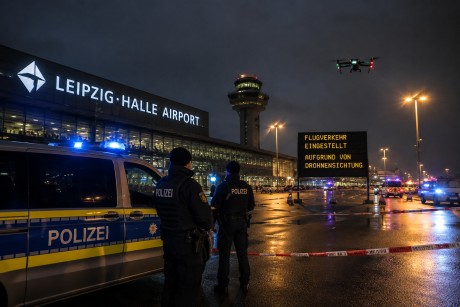
In a significant escalation of tensions, Germany has accused Russia of orchestrating a drone attack at Leipzig/Halle Airport. The German government views this incident as part of a larger campaign of hybrid attacks intended to destabilize the nation and inflict substantial harm. Interior Minister Alexander Dobrindt and Foreign Minister Johann Wadephul revealed that investigators have found evidence suggesting that the Russian state supplied the necessary equipment and expertise for the attempted attack, while lower-level operatives were allegedly recruited to execute it.
The incident unfolded on August 4, when a drone carrying explosives was discovered within the airport’s security area, dangerously close to a Ukrainian Antonov cargo aircraft used for transporting weapons to Ukraine. Although the explosive device failed to detonate, German authorities emphasized that it had the potential to cause significant destruction. Subsequent investigations uncovered traces of the military explosive hexogen near the airport, along with another drone. Initially, authorities suspected a second drone’s involvement in the attack, but this assessment has since been reconsidered.
In response to the incident, Germany is preparing a set of retaliatory measures against Russia. These measures include the imposition of additional sanctions, stricter entry controls for Russian nationals, new restrictions targeting individuals linked to Russian activities, and actions against Russia’s so-called shadow fleet, which facilitates the transport of Russian oil and other goods. Berlin is also advocating for a new European Union sanctions package targeting additional Russian-linked companies and organizations.
German Foreign Minister Wadephul clarified that Germany is not at war with Russia but is increasingly becoming a target of hybrid warfare, which includes alleged acts of sabotage, disinformation, threats, and destabilization. Germany’s European and NATO allies have expressed their solidarity, emphasizing that such attacks cannot be ignored. European leaders have called for a united response to what they perceive as a growing hybrid threat from Russia. Russian President Vladimir Putin, however, dismissed the accusations and criticized the planned sanctions, arguing that they run counter to Germany’s interests.
The German government has briefed its NATO and European partners regarding the investigation and its planned response. NATO Secretary General Mark Rutte confirmed that Germany had presented evidence implicating Moscow, while European Commission President Ursula von der Leyen pledged ongoing support for Berlin. The Leipzig incident marks a significant deterioration in German-Russian relations, already strained to historic lows following Russia’s invasion of Ukraine. German officials and security experts warn that this airport incident may be part of a broader pattern of suspected Russian-linked activities across Europe, including sabotage, drone incidents, and other security threats, which are currently under investigation in several European countries.