
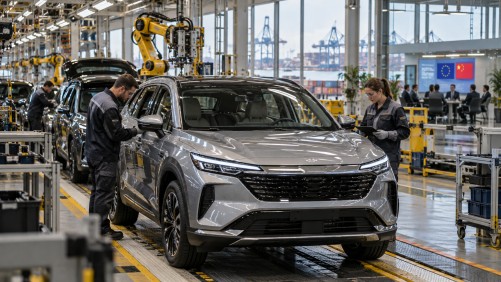
China’s recent agreement with the European Union to limit hybrid vehicle exports could reshape the automotive landscape by prompting Chinese automakers to expand their manufacturing footprint in Europe. As competition intensifies in the European market, this deal is expected to present both challenges and opportunities for Chinese manufacturers.
In the first half of 2026, Chinese hybrid vehicle exports to the EU surged to $7.5 billion, a significant increase from $2.5 billion during the same period in the previous year. This growth can be attributed to the rising popularity of plug-in hybrids, which have remained exempt from the additional tariffs imposed by the EU on fully electric vehicles since 2024. Leading Chinese manufacturers like BYD, SAIC, and Chery have capitalized on this demand, posing increased competitive pressure on European automakers such as Volkswagen.
While the specifics of the agreement, including import quotas and implementation rules, are still being finalized, Chinese authorities claim that the arrangement will allow export growth to continue. Meanwhile, EU officials anticipate that it will gradually limit the volume of imported vehicles. This deal has been seen by some industry executives as a more favorable alternative to escalating trade tensions. Plans for local production could help Chinese manufacturers, such as Changan, maintain their market presence in Europe.
Analysts suggest that the agreement might motivate Chinese automakers to establish more factories in Europe. Larger companies may be able to absorb the investment costs associated with this expansion, but smaller firms could face more significant challenges in increasing their presence. Although the deal may alleviate immediate tariff concerns, uncertainty about future import limits persists, leaving the long-term impact dependent on the final rules and how both Chinese and European manufacturers adapt their strategies.